
Rainy Season Ha Giang Loop Road Conditions 2026: What the Roads Are Really Like Right Now
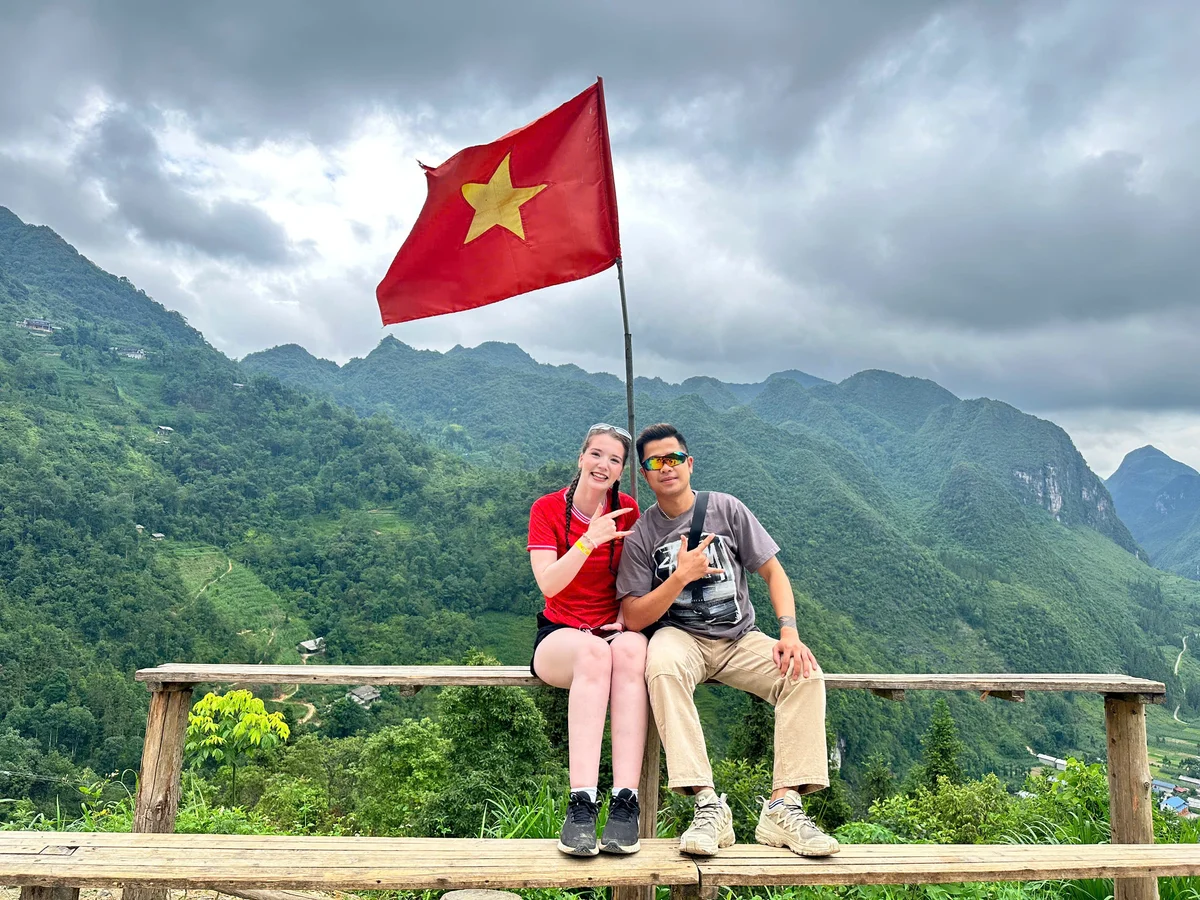
One of the biggest concerns for travelers wanting to do the Ha Giang Loop during the rainy season is the road conditions.
We know you’re already picturing landslides, dangerous roads, torrential rain, and motorbikes disappearing into giant mud pits.
So allow me to bring some clarity.
I recently rode the classic 4-day Bong Hostel route (12th - 15th July 2026) during mixed rainy-season conditions, experiencing sunshine, heavy showers, fog and everything in between.
That’s why I wanted to create an honest, up-to-date guide for rainy season road conditions so you know exactly what to expect before booking your trip.
So, if you're wondering whether the rainy season is still a good time to ride the Loop, keep reading.
When Is the Rainy Season in Ha Giang?
The rainy season in Ha Giang generally runs from around May until September, with the heaviest rainfall usually occurring during July and August.
However, there is one important thing to understand: Rainy season does not mean it rains constantly.
A lot of travelers imagine arriving in Ha Giang and spending four days riding through endless rain. But that’s usually not how it works.
Ha Giang has a mountain climate, which means the weather can change incredibly quickly.
You might:
Wake up to bright sunshine in Ha Giang City
Ride through mist at Heaven’s Gate
Experience a short afternoon shower near Dong Van
Watch the clouds disappear again before sunset
That’s actually exactly what happened during my recent trip.
We experienced a bit of everything:
Sunny sections where the roads were completely dry
Cloudy mountain passes
Light rain where a poncho was more than enough
Heavier showers that simply required slowing down and taking our time
The weather felt less like a week-long monsoon and more like the mountains constantly changing their mood.
Read our full Ha Giang Loop Weather Breakdown.
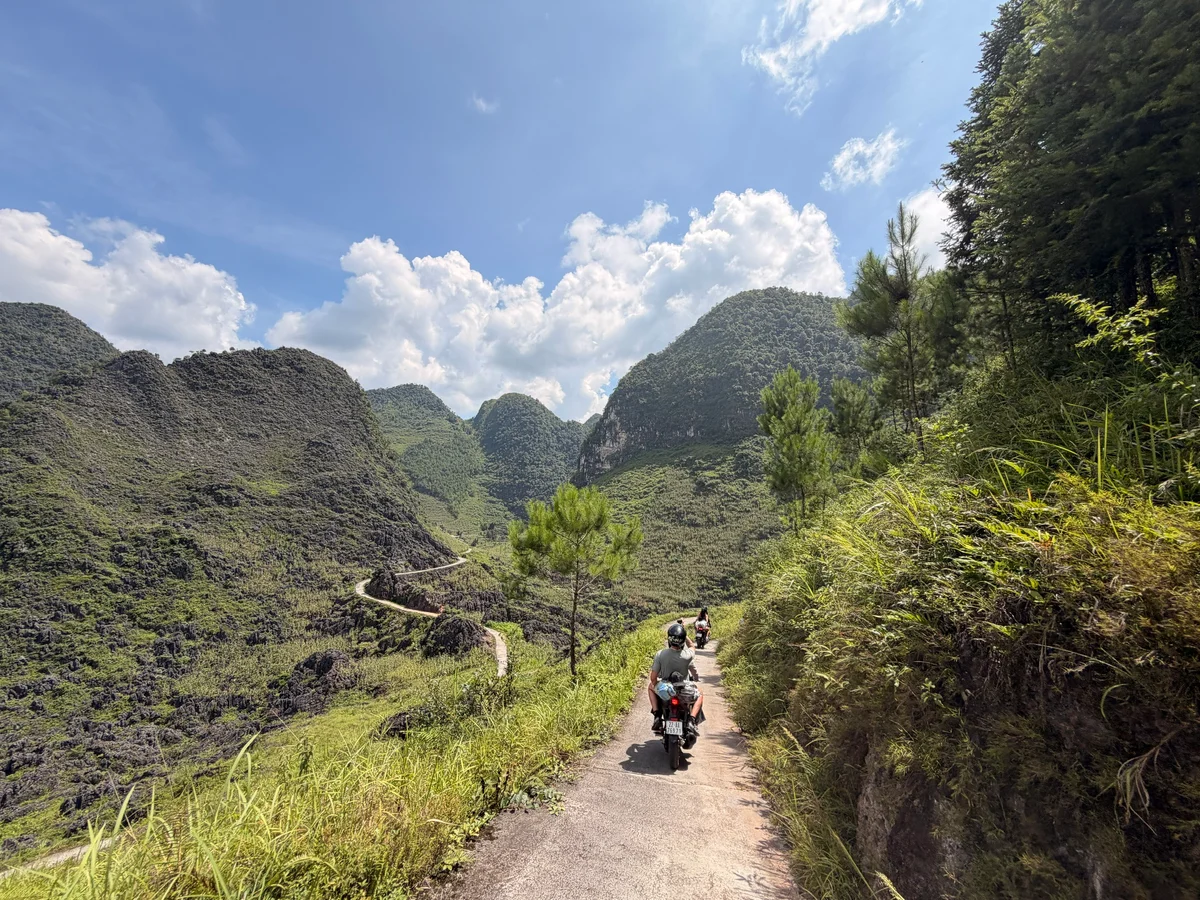
Rainy Season vs Dry Season: Which Has Better Road Conditions?
A lot of people automatically assume the dry season is the "better" time to ride the Ha Giang Loop, but the reality isn't quite that simple.
Yes, the roads are generally drier between October and April, making them slightly easier to ride. However, the rainy season has plenty of advantages that often get overlooked.
While you may encounter the occasional slippery corner or muddy patch after heavy rain, you'll also experience greener landscapes, bigger waterfalls, fewer crowds, and a much more dramatic atmosphere.
Here's a quick comparison between the two seasons:
Rainy Season (May–September) | Dry Season (October–April) |
Occasional slippery patches after rainfall | Drier roads with more predictable conditions |
Mountains and rice terraces are at their greenest | Harvest season is a highlight but often mountains can look less vibrant |
Powerful waterfalls and flowing rivers | Smaller waterfalls and lower water levels |
Fewer tourists at viewpoints | Busier roads and more tour groups |
Dramatic clouds, mist and changing scenery | More consistent weather and visibility |
Requires a little more caution while riding | Generally easier for self-riders |
So, which season is better? Well, they’re both different.
If your priority is the easiest possible riding conditions and clear mountain views almost every day, the dry season has the edge.
But if you're happy slowing down a little in exchange for lush green mountains, roaring waterfalls, fewer crowds, and some of the most atmospheric scenery you'll ever see, the rainy season is incredibly rewarding.
After completing the Loop myself during mixed rainy-season conditions, I can honestly say I never once wished I'd waited until the dry season.
Instead, I felt like I was seeing Ha Giang at one of its wildest and most beautiful times of year.
The Honest Truth About Rainy Season Ha Giang Loop Road Conditions
Let's get straight to the question everyone wants answered.
“What do the roads actually look like right now, in 2026?”
Overall, the rainy season Ha Giang Loop road conditions were surprisingly good.
If you’re picturing the entire Loop as a muddy dirt track with broken roads and washed-out mountain passes, you can relax.
The classic Ha Giang Loop route is mostly paved, and the majority of the roads are in good condition.
Many travelers are surprised by this because older travel videos and blog posts often show much rougher conditions from years ago.
The reality in 2026 is that the main tourist route has seen significant improvements.
Around 90% of the standard Loop route is paved, with regular maintenance happening throughout the province.
That doesn’t mean the roads are identical everywhere… This is still Northern Vietnam so you will be traveling through mountains.
Rain, rockfalls, construction, and road repairs are part of mountain life.
But the idea that the Ha Giang Loop is one giant dangerous off-road challenge is simply outdated.
Rainy Season Ha Giang Loop Road Conditions by Section
Road conditions can change throughout the year, but this gives you a realistic idea of what to expect on the classic route.
Route Section | Rainy Season Road Conditions | Difficulty |
Ha Giang City → Quan Ba | Smooth paved roads with beautiful mountain views. Usually one of the easiest sections. | Easy |
Quan Ba → Yen Minh | Mostly excellent roads with occasional wet corners after rainfall. | Easy-Moderate |
Yen Minh → Dong Van | Good paved mountain roads with some winding sections (we see you Tham Ma Pass!!) | Moderate |
Dong Van → Ma Pi Leng Pass | Good road surface but narrow mountain roads with steep drops down to the Nho Que River. | Moderate |
Meo Vac → Du Gia | The section most likely to have changing conditions, including repairs, gravel, or muddy patches after rain. | Moderate |
Du Gia → Ha Giang | Occasional bad road conditions, in terms of gravel and bumpy patches that last for 10-20 minutes per section. | Moderate-Hard |
The important thing to remember is that the difficulty of the Ha Giang Loop doesn’t come from one terrible road.
It comes from combining:
Mountain terrain
Sharp corners
Changing weather
Long riding days
Paying attention constantly
That’s why experience and patience matter more than simply asking whether the road is paved.
The Rainy Season Road Conditions I Actually Experienced
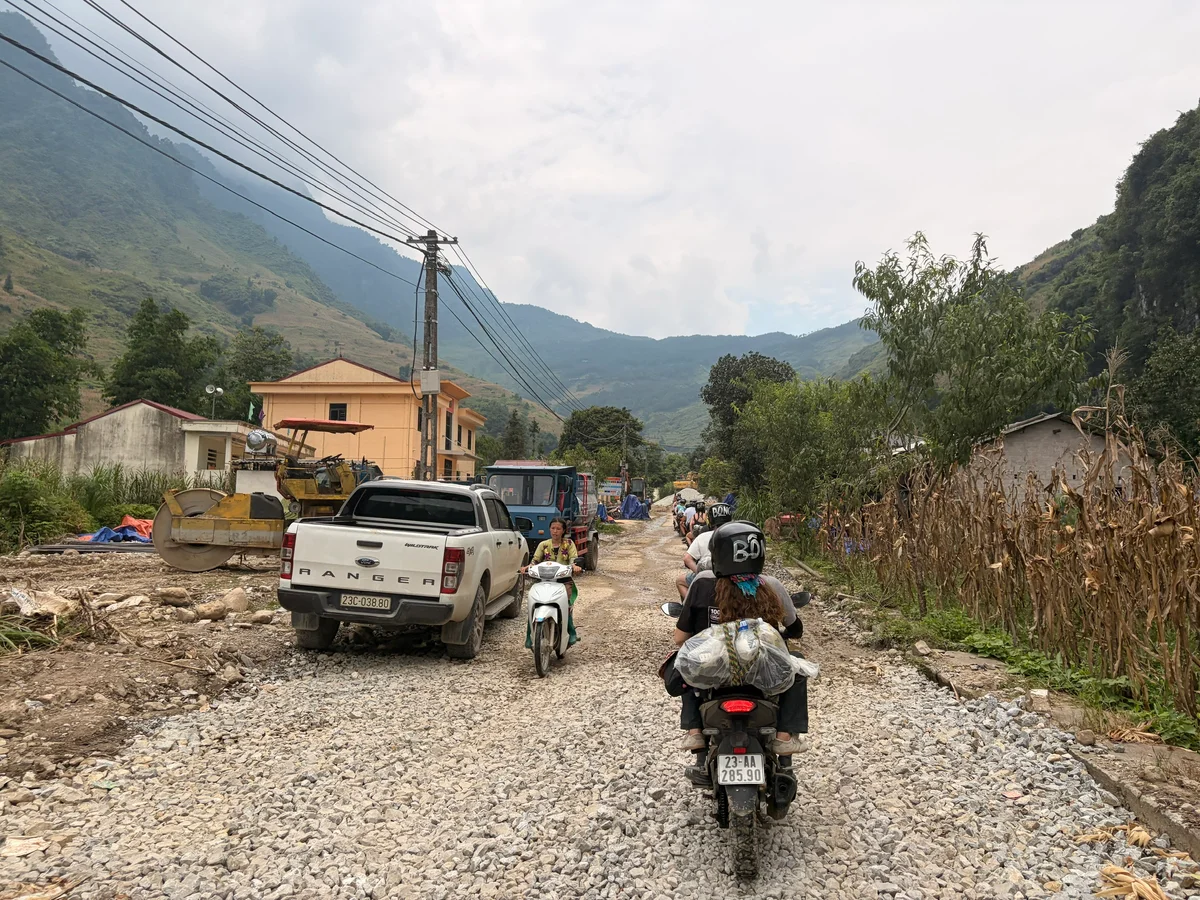
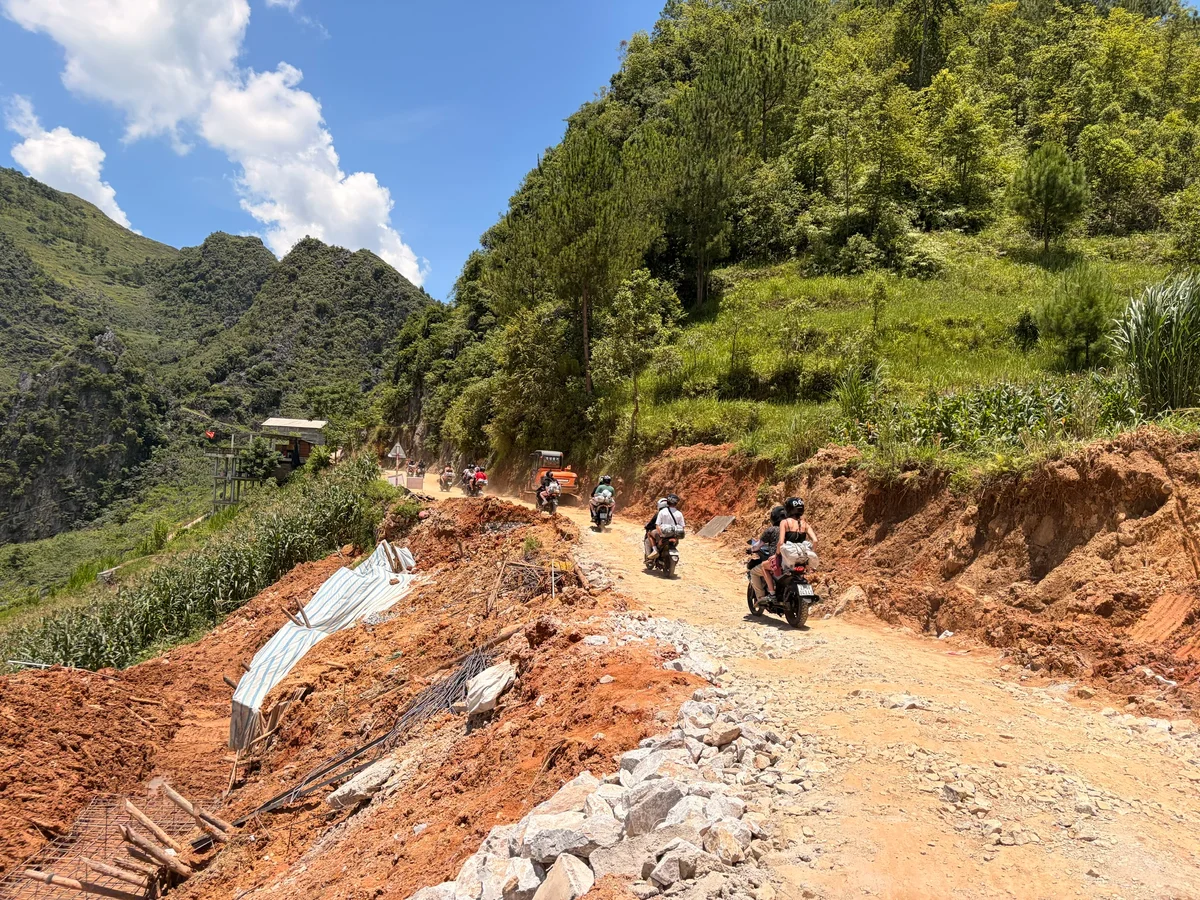
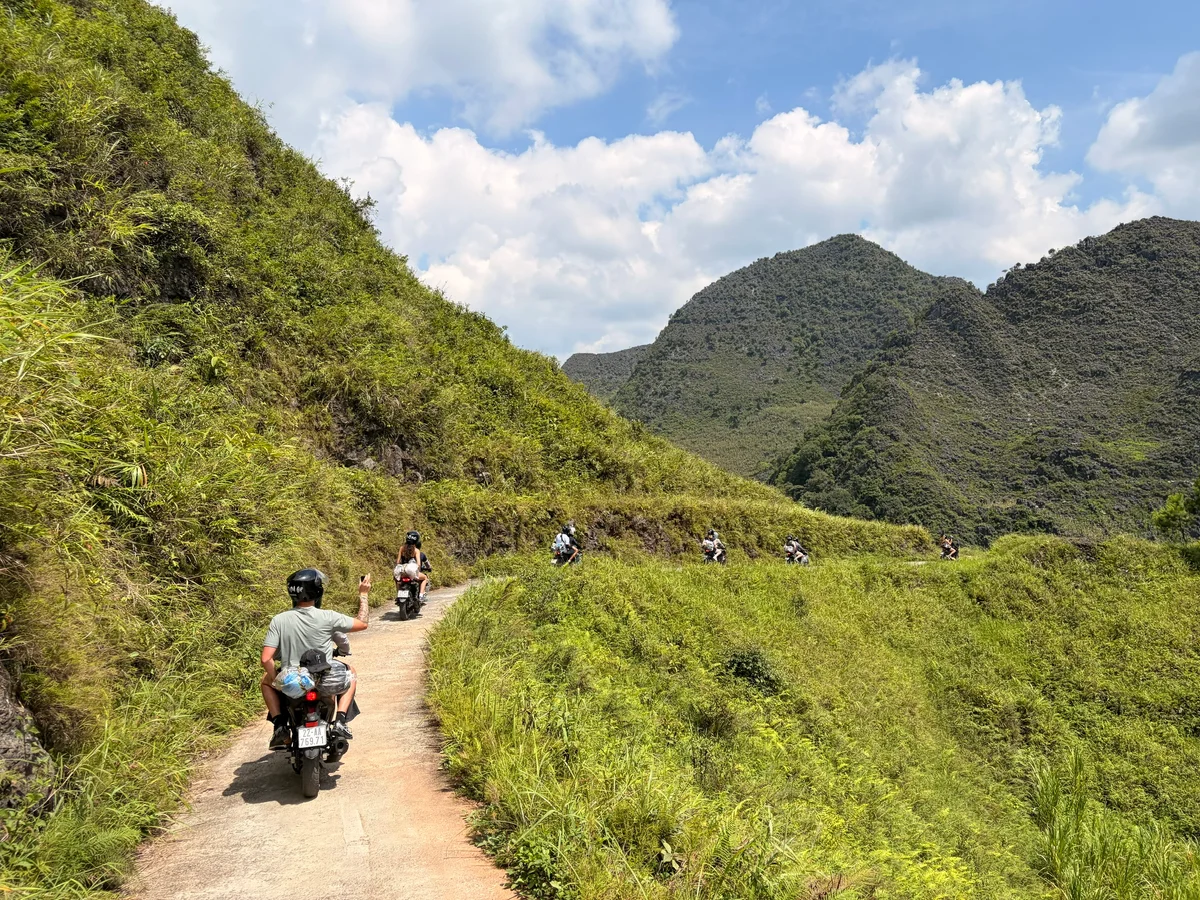
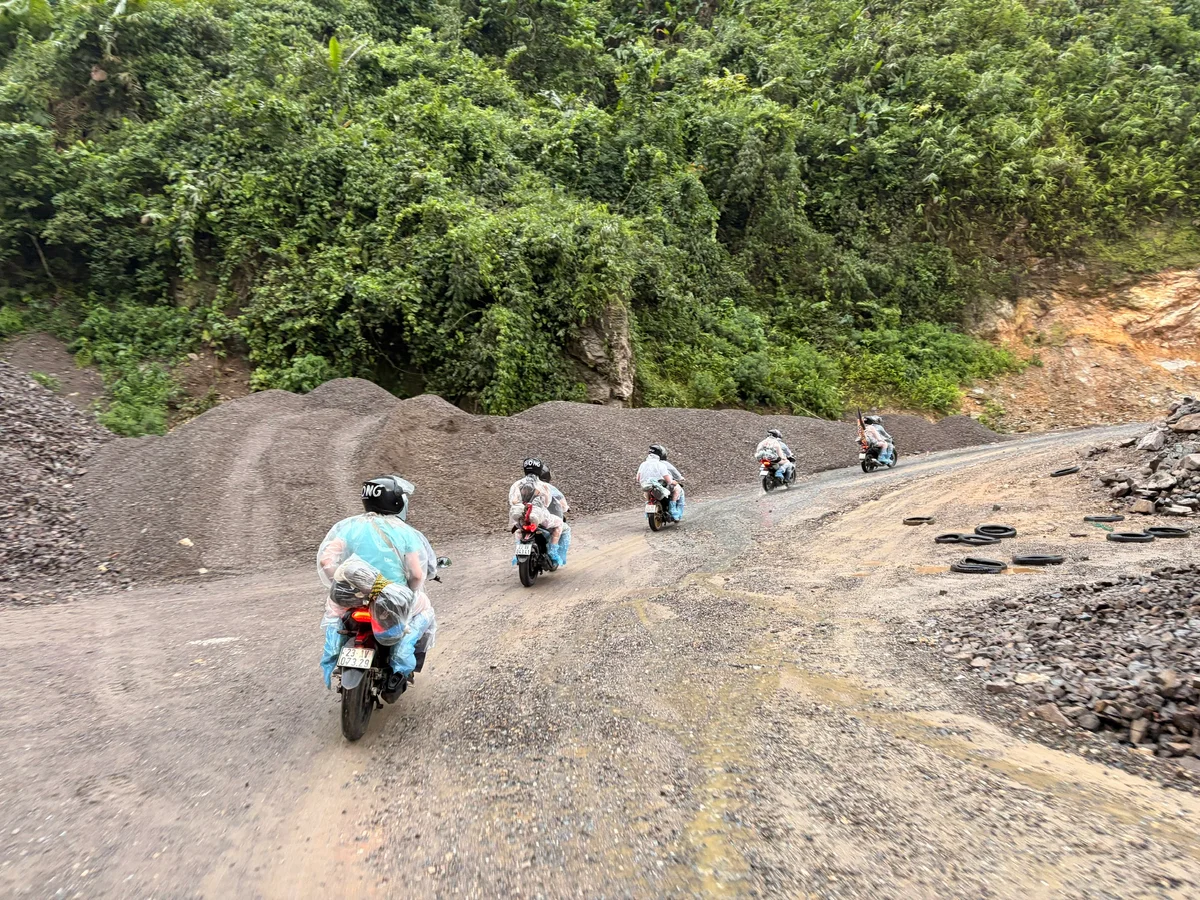
Since I’m including real photos from my recent rainy season ride, I want to explain exactly what you’re looking at.
These aren’t carefully selected photos from the one sunny afternoon of the trip.
This is what the roads genuinely looked like.
During our ride, we experienced:
Good paved roads throughout most of the Loop
Occasional slippery patches after rain
Small muddy areas near mountain edges
A handful of locations where soil had fallen onto parts of the roadside
Active road maintenance crews clearing debris
Some rougher sections around smaller village roads
What we didn’t experience:
Roads completely washed away
Unpassable sections
Constant heavy rain
Dangerous conditions that forced us to stop
Anything that made us feel unsafe
When the rain arrived, we simply put on the ponchos provided by Bong Hostel and continued.
No expensive waterproof adventure gear, no complicated setup.
Our Easy Riders adjusted their speed depending on the conditions.
When roads were dry, riding felt normal, when roads became wet, everyone slowed down, gave more space, and took corners carefully.
That’s really the difference—rain itself is not what makes the Loop difficult, it’s ignoring the conditions that creates problems.
Why Are Ha Giang Roads Better Than People Expect?
A lot of travelers arrive expecting something completely different.
They imagine narrow dirt tracks, broken roads, and hours of uncomfortable riding.
But the main tourist route has improved dramatically.
There are a few reasons for this:
1. The Ha Giang Loop Is An Important Tourism Route
Ha Giang has become one of Vietnam’s biggest adventure tourism destinations.
Thousands of travelers complete the Loop every year, meaning maintaining the roads is important for both tourism and local communities.
2. Road Crews Regularly Repair Damage
Mountain roads naturally need maintenance.
Heavy rain can cause:
Small landslides
Loose rocks
Mud build-up
Drainage issues
But local crews are constantly working to clear and repair affected areas.
During my own ride, I saw evidence of this.
Some areas had clearly experienced recent issues, but they were already being managed.
3. Older Videos Don’t Always Show Current Conditions
If you’ve watched Ha Giang Loop videos from years ago, you might have seen much rougher roads.
Those videos aren’t necessarily wrong.
They’re just not always showing what travelers will experience today.
Find out whether the Ha Giang Loop is Still Worth it in 2026.
Why Rainy Season Roads Feel Different
Even when roads are in good condition, rain changes how they behave.
Mountain roads naturally become slicker after showers
Water can wash small amounts of gravel onto corners
Mud can collect on the edges of roads
Visibility can change quickly as clouds move through the valleys
This doesn't mean panic is required, it simply means paying attention.
Local Easy Riders have spent years navigating these roads in every weather condition imaginable.
They know where slippery corners tend to appear and which sections require extra caution.
It's one of the reasons so many travelers choose Easy Riders during the rainy season.
Instead of worrying about every bend in the road, you can focus on enjoying the views.
Fog on the Ha Giang Loop During Rainy Season
One thing that surprises many travelers during the rainy season is just how quickly visibility can change.
Ha Giang is full of different elevations, valleys, and mountain passes, which means the weather can completely transform within a short distance.
You can leave Ha Giang City under blue skies and find yourself surrounded by thick clouds at a higher viewpoint less than 30 minutes later.
During my rainy season ride, we experienced several periods where mist rolled through the mountains, creating those incredible cinematic moments where the whole landscape looked like something from a fantasy film.
But let’s be honest—fog can also be slightly frustrating.
You might arrive at a famous viewpoint and think: “Wow, this would probably look amazing… if I could actually see anything.”
That’s the rainy season trade-off.
You might not always get the perfectly clear postcard photo, but you often get something more atmospheric and unique.
And when the clouds finally lift, the views feel even more rewarding.
Are Landslides a Problem During the Rainy Season?
This is probably the biggest concern people have when searching for rainy season Ha Giang Loop road conditions.
And it’s understandable.
Heavy rainfall can sometimes cause:
Small landslides
Mud falling onto roads
Loose rocks
Temporary road disruptions
But there is a big difference between “landslides can happen” and “the whole Loop is constantly dangerous”.
During my recent trip, we saw a couple of areas where sections of the roadside had been affected.
There were patches where mud and debris had come down from the mountainside.
However, the important thing was that:
The roads were still open
Traffic was still moving
Crews were actively clearing the affected areas
Our drivers knew exactly how to navigate the sections safely
This is something worth remembering: Mountain roads are living roads.
Conditions change
A section that looks perfect one month might need repairs after a storm
A section that looks slightly messy today might be completely fixed tomorrow
This is why traveling with local drivers can make such a huge difference; they’re not relying only on Google Maps. They know the roads because they live there.
Which Parts of the Ha Giang Loop Have the Most Variable Road Conditions?
Typically weather, construction, and repairs constantly change conditions. But some areas naturally experience more variation.
1. Du Gia and Smaller Village Roads
The roads around Du Gia are often mentioned because they can include more changing surfaces.
You may encounter:
Smaller roads
Uneven sections
Gravel
Village traffic
Recent repairs
Mud after heavy rain
This doesn’t mean Du Gia is dangerous.
Actually, many travelers consider it one of the most beautiful parts of the Loop.
It simply means it requires a little more attention.
2. Mountain Corners
Even on excellent paved roads, corners deserve respect.
Rain can wash small amounts of gravel or dirt onto the road surface.
This is especially important on:
Sharp bends
Downhill sections
Narrow mountain roads
The biggest mistake riders make is not the road itself, it’s entering a corner too quickly.
3. Construction Areas
North Vietnam continues improving infrastructure throughout Ha Giang.
That means you may occasionally see:
Road workers
Machinery
Temporary surfaces
Fresh repairs
Usually, these sections are manageable and clearly visible.
Should You Cancel Your Ha Giang Loop Because Rain Is Forecast?
Not necessarily no.
A rainy forecast in Ha Giang does not automatically mean your trip will be ruined. As I've said before, mountain weather is unpredictable.
A forecast saying “rain” doesn’t necessarily mean four days of misery.
It often means: “There is a chance you might experience some rain somewhere in this huge mountainous province.”
Many rainy season trips still include:
Sunny mornings
Clear viewpoints
Beautiful mountain roads
Incredible scenery
However, there are situations where caution is needed.
If there is:
A major storm
Severe weather warning
Dangerous road conditions
Significant flooding
Then plans may need to change.
Safety always comes first.
At Bong Hostel, our team and Easy Riders monitor conditions and make decisions based on what is actually happening on the ground.
Because the weather forecast is useful, but local knowledge is better.
What Happens If Conditions Become Unsafe?
This is one of the biggest advantages of booking a guided Ha Giang Loop tour.
You’re not dealing with changing mountain conditions alone.
Before and during the trip, our team and Easy Riders stay aware of:
Weather conditions
Road updates
Local warnings
Areas requiring extra caution
If a section is not safe, the plan can be adjusted.
Sometimes that might mean:
Taking a different route
Waiting for conditions to improve
Slowing down the schedule
The goal is simple: Make sure you experience Ha Giang without unnecessary risk.
The Loop is an adventure so it should feel exciting, not stressful.
Is the Ha Giang Loop Safe During the Rainy Season?
The honest answer is: Yes, it can be, but it depends on how you do it.
For experienced riders who are comfortable on mountain roads, the rainy season can be an amazing time to visit.
For beginners who have never ridden a motorbike in the mountains before, the rainy season is not the easiest introduction.
The challenge is not one single thing.
It is the combination of:
Wet roads
Sharp turns
Changing visibility
Long riding days
Mountain terrain
Unpredictable weather
This is why Bong Hostel recommends an Easy Rider for many travelers during the rainy season.
Not because the Loop is dangerous. But because you are here to enjoy the experience.
Not spend four days gripping the handlebars wondering when the next patch of gravel is.
Read more about the Rainy Season on the Ha Giang Loop: Tips, Safety, & What to Expect.
Why Easy Riders Make Even More Sense During Rainy Season
An Easy Rider completely changes the experience.
Instead of focusing on:
Whether the road is slippery
Where the next turn goes
Watching the weather
Avoiding every puddle
Not to mention, managing your alcohol intake (Vietnam has a strict zero tolerance policy) and ensuring you have the correct licensing so that you can legally drive here.
You can focus on:
Taking photos
Talking with your driver
Enjoying the scenery
Meeting other travellers
Stopping for coffee
Experiencing local villages
One of the best parts of having an Easy Rider is the local knowledge.
Your driver knows:
Where to slow down
Which viewpoints are worth stopping at
Where the weather usually changes
Which roads need extra attention
They have ridden these roads in sunshine, rain, fog, and everything in between.
The Unexpected Benefits of Riding the Ha Giang Loop During Rainy Season
The rainy season often gets treated like the “less ideal” time to visit Ha Giang.
We disagree. It’s just different, and different can be incredible.
1. The Mountains Are Extremely Green
Rain transforms the landscape.
The hills dotted with rice terraces turn bright green, which makes the valleys feel more alive.
If you love dramatic scenery, the rainy season delivers.
2. Waterfalls Become Much More Powerful
This is one of the biggest advantages of traveling during the wetter months.
After rainfall, waterfalls around Northern Vietnam become far more impressive.
Small streams turn into rushing cascades, and little waterfalls appear by the roadside that don’t exist in the dry season.
3. The Temperatures Are More Comfortable
Ha Giang can become hot during summer.
Rain doesn’t remove the humidity completely, but it does provide welcome breaks from the heat.
A short shower while riding through the mountains can actually feel refreshing.
4. Fewer Crowds
The rainy season usually sees fewer travelers compared with the busiest months.
That means:
Quieter viewpoints
More relaxed stops
A more peaceful atmosphere
Sometimes the weather scares people away and sometimes those people miss the best experiences.
Read more about Tourism on the Ha Giang Loop: How to Avoid the Crowds in 2026.
What Should You Pack for the Rainy Season Ha Giang Loop?
Well the good news is that when packing for the Ha Giang Loop in the rainy season you don’t need to buy a full expedition wardrobe.
I completed the Loop wearing the ponchos provided by Bong Hostel.
They’re:
Simple
Practical
Effective
However, I do recommend bringing:
Lightweight waterproof jacket
Quick-drying clothes
Spare socks
Power bank
Light jumper for evenings
Non-essential extras:
Waterproof phone pouch
Small dry bag
The biggest mistake travelers make is bringing too much.
You do not need to pack your entire wardrobe—just a few smart items that keep you comfortable.
Discover What to Wear on the Ha Giang Loop in the Rainy Season.
Can Buses Still Reach Ha Giang During Rainy Season?
Yes, buses continue operating throughout the rainy season. However, during periods of extreme weather, delays can happen.
Heavy storms or major road issues may occasionally affect travel times.
That’s why we always recommend leaving some flexibility in your schedule.
Don’t plan a Ha Giang Loop that finishes five minutes before your international flight.
Give yourself breathing room.
FAQs: Rainy Season Ha Giang Loop Road Conditions
Can beginners do the Ha Giang Loop during the rainy season?
Yes, but we recommend beginners choose an Easy Rider rather than self-driving.
The roads are manageable, but mountain riding requires concentration and confidence, especially when conditions are wet.
Do Easy Riders still operate when it rains?
Yes. The rainy season is a normal part of life in Ha Giang.
Our Easy Riders regularly complete tours throughout the wetter months and adjust depending on conditions.
Will I still see the views if it rains?
Sometimes yes, sometimes no. That’s the honest answer.
Some viewpoints may be covered by clouds, but the rainy season also creates incredible misty landscapes and greener scenery.
Do waterfalls get better during the rainy season?
Absolutely. Rain gives waterfalls more power, making them one of the highlights of traveling during the wetter months.
Do I need expensive rain gear?
No. A good poncho, dry bags, and quick-drying clothes are usually enough for most travelers.
How often do roads close?
Temporary disruptions can happen after heavy storms, but major closures are not common on the main tourist route.
Final Verdict: Are Rainy Season Ha Giang Loop Road Conditions Good?
If you searched “rainy season Ha Giang Loop road conditions” hoping for a simple yes or no answer, here it is:
Yes, you can do the Ha Giang Loop during the rainy season.
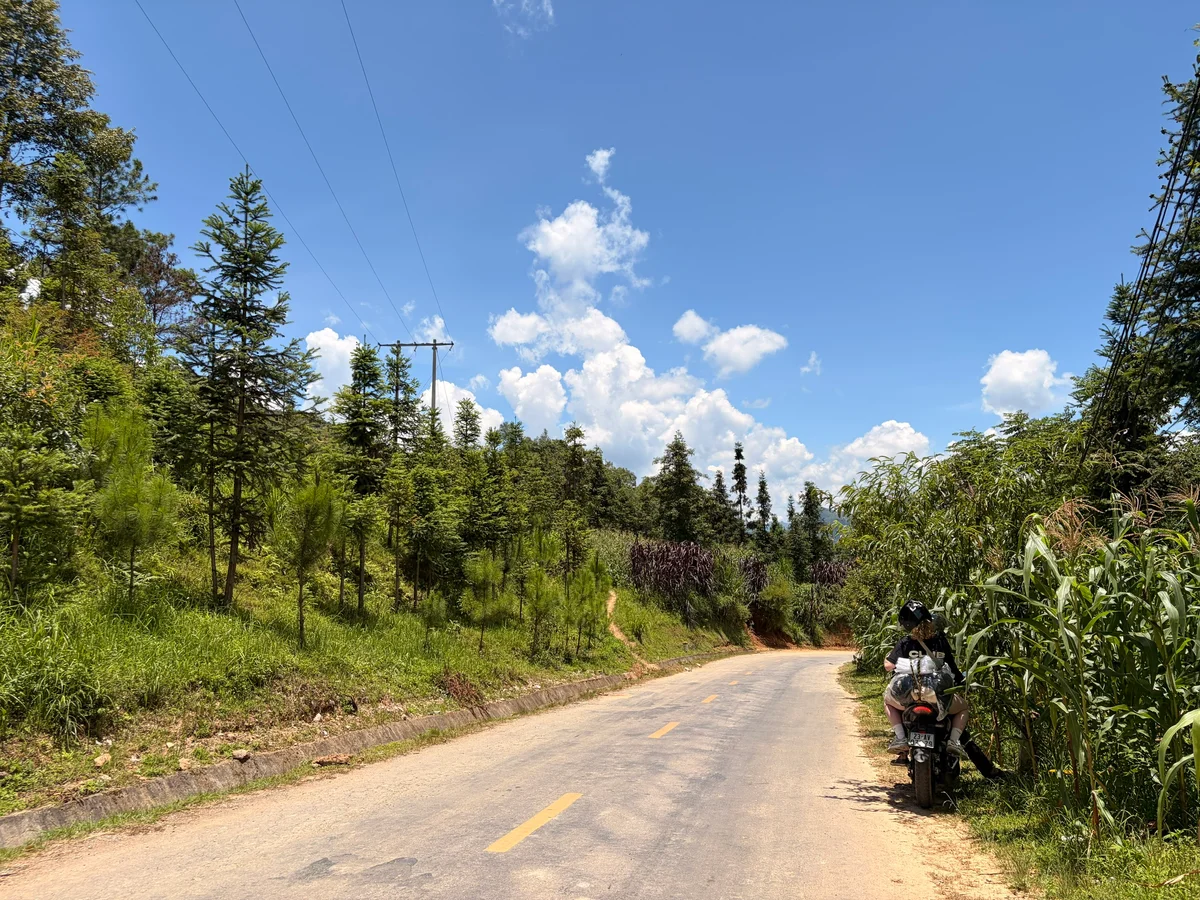
The rainy season road conditions are generally much better than people expect.
There will be rain, fog, and mud but the Loop is not the dangerous, impossible adventure that some outdated blogs make it sound like.
After completing the route myself during mixed rainy-season conditions, my biggest takeaway was:
The roads were good
The scenery was incredible
The rain was bearable
And with experienced Easy Riders, I felt completely comfortable throughout the journey.
If you want guaranteed sunshine every day, the rainy season probably isn’t for you.
But if you want greener mountains, bigger waterfalls, dramatic clouds, fewer crowds, and a more adventurous version of Ha Giang?
It might actually be the perfect time.
Ready to Experience Ha Giang during its Greenest Season?
About Faye Hilling
Travel writer and Vietnam explorer sharing authentic experiences and insider tips for discovering the beauty of Vietnam.